See who is slipping — before the exam
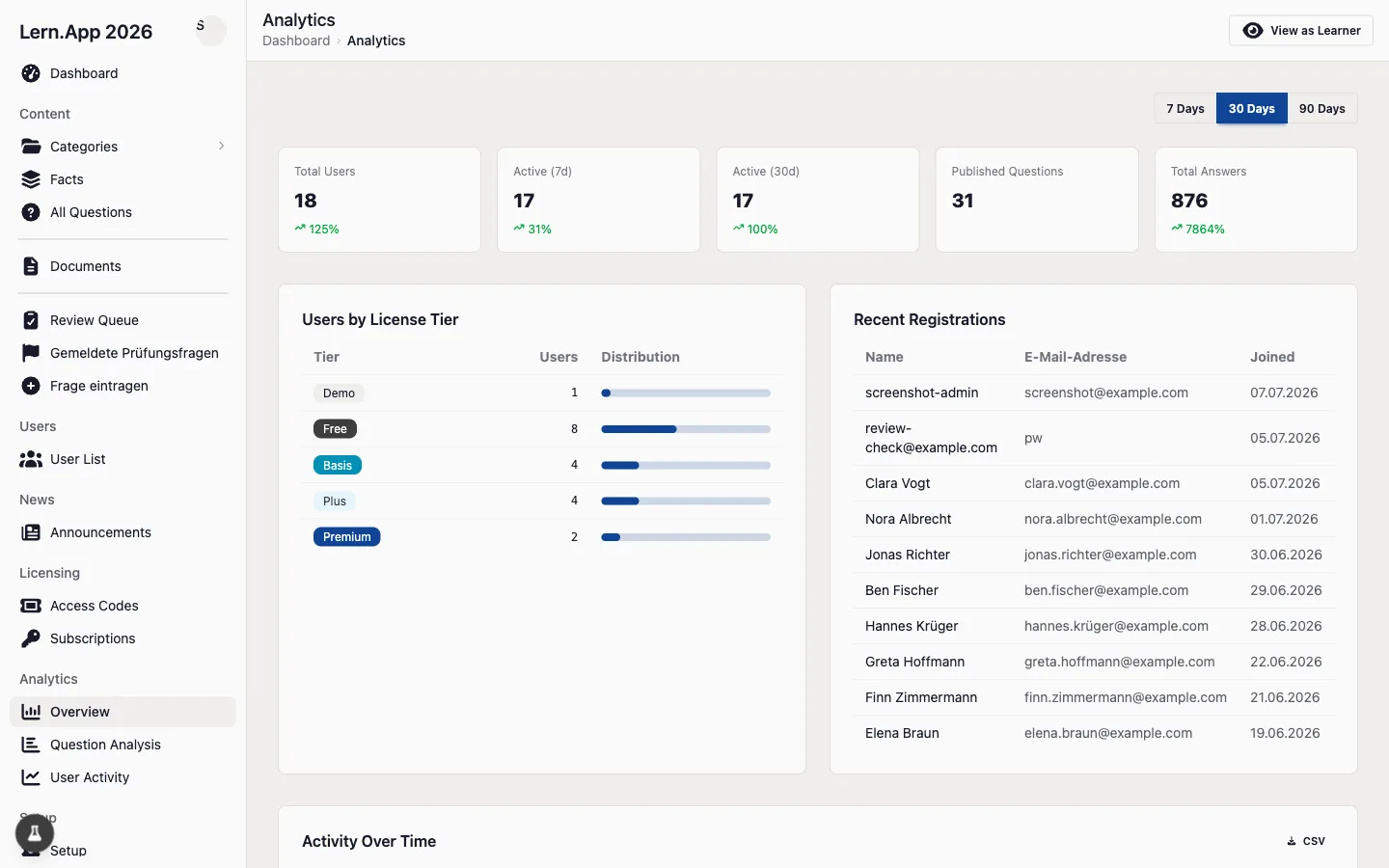
You see who is on track — and who is at risk, before the exam shows it.


Because enthusiastic participants are your best advertising.
turns your seminar materials into adaptive practice questions — on your domain, with visibility into your participants' progress.
Built for exams such as: non-medical psychotherapy practitioner licence · EU licence · boating licence · firearms licence · hunting licence · German Chamber of Commerce (IHK) exams
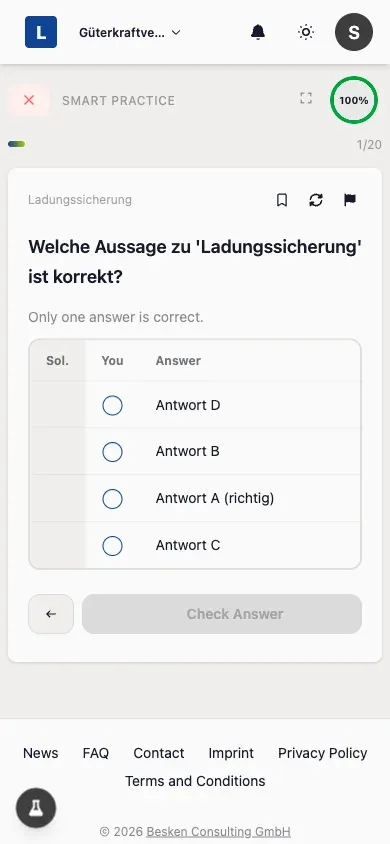
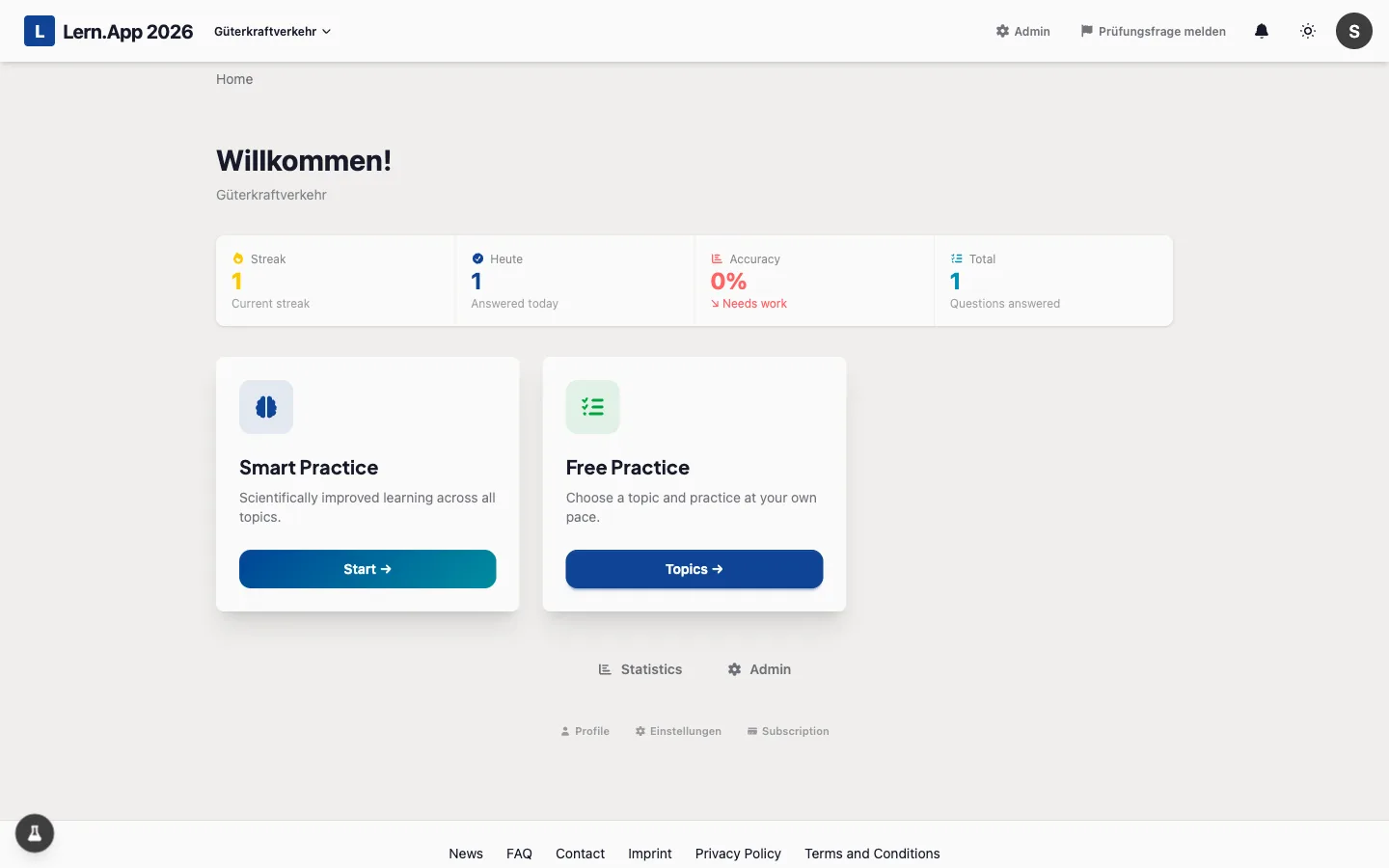
This is what your participants experience
The challenge
In the seminar everything is convincing. The questions come back the moment someone has to produce the answer themselves — and that is where real gaps in understanding surface. People do practise between the seminar and the exam. Just rarely in a way that exposes those gaps while there is still time to close them.
starts exactly thereYour materials become practice questions that require an answer of one's own — not just recognition. Whatever does not hold up then shows in the learning record: for your participants and for you, while there is still time.
Four weaknesses sit in the usual practice formats themselves — not in the work anyone put into them.
Multiple-choice questions that aren't carefully designed can partly be solved by guessing or pattern recognition. Answering one correctly does not mean knowing what it was about.
A hand-maintained question bank is finite. Work through it three times and you recognise the questions — not necessarily the matter behind them. The exam, though, tests against the examining body's requirements, not against the bank you practised on.
Practise almost exclusively with yes/no questions and half of them can be guessed right — the learning level on display is then not the real one. What is also missing after a change of format is routine in handling the task type.
Flashcard and Leitner systems leave it to learners to grade themselves. That judgement is reliably too optimistic — well studied. Overestimate yourself and you stop practising too early, and the gap goes unnoticed.
The upward spiral
Better preparation does not work just once — it pays in more strongly with every cohort.
Better preparation
Higher pass rate
Satisfied participants
More and better reviews
More sign-ups
More participants practising
… and the last step leads back to the first.
And the last step closes the loop technically, not just rhetorically: from 20 answers per question onwards, the app measures the actual solution rate and replaces the estimated difficulty with it. More participants make your questions measurably better.
Benefits
An exam preparation your participants pass — with visibility for you.
You see who is on track — and who is at risk, before the exam shows it.
Smart Practice targets each participant's weak spots — everyone practises what has not stuck yet, instead of whatever the course happens to be covering.
Participants subscribe or redeem access codes — Stripe and PayPal billing is built in. One seminar becomes an ongoing income stream.
Your domain, your logo, your colors. Your participants experience the platform as your product.
You hand over your materials and we build your platform. Later you can create and manage questions yourself — but you never have to.
What sets us apart
Your participants pass because they master the material.
And you can show it, fact by fact.
The app almost never shows material to read. It asks. Every question is therefore less a test of what is known than the act of learning itself.
What is learned is the fact, not the question. The same matter is asked in changing wordings and question types — anyone who merely memorised one answer does not get through.
Other adaptive systems lock away whatever is not due. We only re-sort. Easy questions appear in the exam too — whoever never sees them again loses them.
The difference
Two points where practice and the exam part company — and what lern.app does differently there.
How often do you flip a flashcard, have roughly the answer in mind, and tick it off? People grading themselves regularly overestimate what they can actually retrieve — this is well studied. Nor is it carelessness: nobody holds their own answer neutrally against their own expectation. That takes a second party.
On top of that: a thought feels complete as long as it stays unspoken. Especially where something has to be explained, only putting it into words reveals where it has holes. A thought merely had is not yet a thought conveyed.
That is why the answer in lern.app is actually typed or spoken. Where it is typed, your own judgement does not decide right from wrong — it is checked against the stored fact. On a spoken flashcard the AI assesses first and says why. Four of six questions per fact call for an answer you produce yourself rather than a click.
Flashcards and self-assessment therefore stay permitted — they are simply not the only measure. Where "I had it in my head" says too little, graded input and spoken formats step in alongside them.
Talking a case through with a real examiner: once is feasible, fifteen times is not. Oral preparation fails not on willingness but on one person's capacity. That is the limit AI removes — it does not replace an examiner, it makes possible something that did not exist before.
You sit down exactly once and define the case: the situation, the sequence of questions, the expected points, and an examiner persona if you want one. After that the run repeats as often as your participant wants — bounded only by your plan's allowance, not by an examiner's spare time. The AI examiner leads through the case and follows up on unclear or incomplete answers. Wording may differ every time; the assessment is against the same expected points.
Different cases, different conversations, thorough preparation — without depending on an examiner's scarce time. Whatever stays unresolved, your participant then takes up with you in one go rather than one at a time. You are needed once, not fifteen times.
What is practised
Quiz and flashcard tools only know the first rung. Exams ask for all four.
Recalling a matter of fact. The foundation — without retrievable details there is nothing to connect.
Holding two or three facts against each other. Transfer arises from comparing, not from repeating — a question about a single fact cannot produce it.
Applying a procedure. Procedures rarely fail for lack of facts, but because several elements must be held in mind at once.
Judging a case. The case supplies the context in which the knowledge is needed.
The sequence is a recommendation, not a lock: anyone who already has the schema starts straight in.
How questions are asked
Variety keeps your participants engaged and trains different skills — from quick recall to application.
Questions with several answer options — one or more correct.
Quick true-or-false decisions.
Open text answers, graded automatically.
Classic recall with self-assessment — answered by voice if preferred.
Filling missing terms into the text.
Naming areas on an image.
Arithmetic tasks with a checked result.
Talking through a case step by step.
Listening to a recording and answering.
A case with multiple-choice and cloze questions bound to it.
AI as an enabler
A human examiner remains valuable for subject-matter clarification. Their available time does not grow with every extra practice run. AI makes a case that has been defined once reusable for further conversations.
The provider defines the case, question sequence, expected points and, if desired, an examiner role. The same subject-matter framework can be reused for further conversations.
The AI examiner guides learners through the case, follows up on unclear or incomplete answers and then evaluates the complete conversation against the same expected points. Wording may vary; the subject-matter standard remains stable.
Different cases and repeated runs do not require a new appointment each time. Open subject-matter questions can be collected and then discussed with the course provider as a focused bundle.
The number of AI-supported runs included depends on the provider's offer and AI allowance.
Win, win, win
An exam involves three parties. Preparation only holds up if it works for all three.
They practise the matter rather than a fixed question: the same fact returns in changing wordings and question types, and whatever did not hold up last time comes back around.
They know the exam situation because they have been through it many times: format, time pressure and question types hold nothing new on the day. Whether that takes away exam nerves differs from person to person — it is not promised.
And they have a position fix: where do I stand, where are my gaps, what do I work on next? The feedback names the material, never the person.
Until now: a change in the law — and then the question is not where it is written, but in how many versions. Script, slides, printed handouts in a running course, your tutors' own questions. Which of them has the new version?
With us nothing hangs on individual questions; everything hangs on the facts. Correcting a fact automatically flags every question built on it — including those that merely use it alongside others. You see at once what needs review, and decide question by question.
Plus the feedback across all participants: if sixty out of a hundred get the same question wrong, either the question is poorly worded — or you have found a widespread misconception you can address in the seminar. A pointer no printed script gives you — what you do with it is your call.
Examination regulations do not aim at a high pass rate; they aim at evidence that someone can do what they require. That is what the practice is aligned to.
Anyone who has practised this way has answered the same fact in changing wordings and question types — rather than repeating one fixed question.
Tasks that carry a matter over to a new case show more than plain recall — they require holding two or three facts against each other.
How it works
It does not get simpler — you supply the content, we take care of everything else.
Send us your scripts, slides or question catalogues — in any common format.
We turn your content into adaptive practice questions and set up your platform on your domain — later you can maintain and extend the content yourself.
Your participants practise on their own — the algorithm makes sure gaps in knowledge are closed systematically.
is notWhere this comes from
lern.app was not designed at a drawing board. Its founder, Julian Besken, is an airline pilot on long-haul routes — a profession in which exams do not end with training but keep coming back for as long as the licence is to remain valid.
Training meant several internal exams with several thousand questions. Passing those earned admission to the examination by the Federal Aviation Office: thirteen subjects in three days, all multiple choice.
One thing stood out more than once: recognising the answers makes you feel certain. Let the options differ only slightly and that certainty collapses — taking with it the composure an exam requires. That one's judgement of one's own knowledge can be misled this way is not a one-off; it is well studied.
That is precisely why lern.app brings the same fact back in changing wordings and question types instead of one unchanging question. Added to that was a long-standing interest in how and why people learn — and the wish, having reached one's own goal, to help others reach theirs.
We build sample platforms for individual exam areas — openly accessible, so you can get a picture.

Candidates preparing for the official examination
A sample platform we built: facts from the exam syllabus, practice questions in several formats, progress tracked per fact.
Participants in recreational boating licence courses
A sample platform for an exam with a fixed question catalogue: rules, navigation and chart tasks as their own question types.
Frequently asked
Your materials remain your property. The practice questions we create from them exist exclusively for your platform — we use your content for nothing else.
Usually a few weeks from handing over your materials — depending on scope. We agree on the concrete timeline in the intro call.
On servers in the EU. AI generation runs via Mistral in the EU by default. Every provider gets their own separate instance with its own database. GDPR data export and deletion workflows are built in.
Your own domain, your own logo, your own colors. Your participants see your brand only.
You keep them current yourself — you don't have to send us anything. A combined semantic and keyword search runs across all stored facts, so after a change in the law you'll find every fact affected by it in seconds and can correct, refine or retire it right there. Every question built on those facts is automatically flagged for review.
You see how your participants actually learn: which questions are hard, where comprehension breaks down across all learners, which topics are repeatedly answered wrong. That tells you where your seminar or your materials need work — insight you cannot get from a printed script.
Yes. We set everything up for you, and from then on you can create, edit and review questions in your own admin whenever you want — or leave it to us.
The structure is settled: a one-time setup plus ongoing operation, scaled by scope and number of participants. We are not quoting list prices yet — we are at the beginning. One established training provider already works with us, and we are looking for further reference customers, who come in on markedly reduced terms. Naming a figure we would have to withdraw after the first months of operation would not be honest; we will tell you the order of magnitude for your case in the intro call.
However you prefer: you hand out access codes to your seminar participants, or participants book access directly as a subscription — both are built in.
We turn them into practice questions for your platform — nothing more. For text recognition and question generation the content passes through Mistral in the EU, our data processor; it is not used for model training there and is not passed on to anyone else. After the setup we delete the materials on request.
You do — nobody else. We generate the questions, set quality criteria and check against them automatically; and we tune the generation together with you until it fits your material and your exam. The subject-matter approval stays with you or your staff. There are dedicated reviewer accounts for exactly that: a workplace for checking, correcting and approving questions, kept separate from the administration of your platform.
No — and we would rather say so up front than afterwards. Your materials are yours and you get them back at any time. The facts and questions built from them stay on the platform: they are our work, and we do not build them so that a separate product can be made from them elsewhere. We are looking for a lasting collaboration, not a supplier relationship. Your participants' rights are untouched — their data export and erasure under GDPR are built in.
As often as they like, for as long as your plan's allowance lasts. The difference from a human examiner is not that there is no limit — it is that the limit is a number you know, rather than one person's spare time. How exactly those allowances are cut is something we are currently tuning against real usage: hardly anyone practises orally every day; most run the simulation a handful of times before the exam.
Let's talk briefly and see what your platform could look like.